Or write to support@educaplay.com
AsterQuiz: what it is and how to make one
What it is
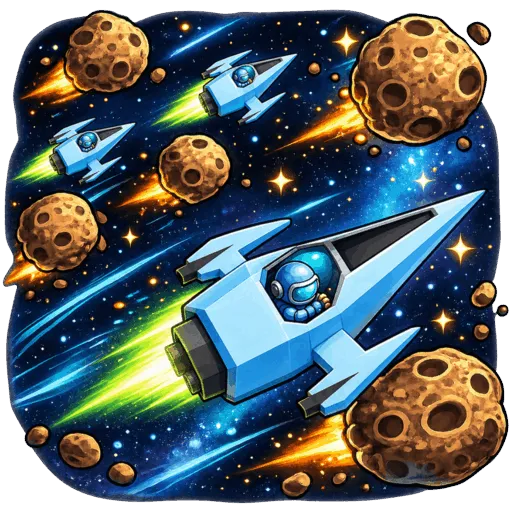
AsterQuiz is a question game set in space, halfway between a quiz and an obstacle race. The player pilots a fleet of ships that moves on its own down a four-lane corridor; each question arrives as a wave of gates, one per answer, and you have to place your fleet in the lane with the correct answer before the wave goes by.
Each correct answer doubles the fleet and each mistake halves it, so the size of your fleet tells you how the game is going. The game ends when you reach the space station.
Each question has 3 answers by default, though you can add more or leave it at 2 (for True/False questions). Questions and answers accept text, images and/or audio.
What the player finds along the way
- Wave of gates: this is the question. Each answer takes up a lane; the leftover lanes hide a nebula. Getting it right doubles the fleet; getting it wrong leaves it at half.
- Nebula: crossing a lane with no answer does not answer the question (it is left pending for the black hole) and wipes out half your fleet.
- Stray ships: in the open stretches, ships appear that you can collect to grow your fleet.
- Asteroid belt: a ring of rocks blocks the corridor. You have to stay in one lane while the fleet fires to blast its way through; the more ships you have, the sooner it breaks. If you run out of time, the impact costs you part of the fleet.
- Black hole: this is where the questions you got wrong come back, with a countdown and the hole biting off ships while you take your time. Getting it right frees the fleet; getting it wrong keeps it inside and the question goes back into the queue.
- Space station: the finish line. You reach it when there are no questions or retries left ahead.
Controls
- On a computer: use the left and right arrow keys to change lane or click an answer; the up and down arrow keys to speed up or brake.
- On a phone or tablet: drag your finger sideways to change lane or tap an answer directly; slide forward or backward to speed up or brake.
Speeding up carries no penalty: in the asteroid belt it only brings the outcome forward, and with Speed up on answer streaks turned on, answering quickly while the wave is still far off gives you extra reinforcement ships.
Examples of use
- Mental maths and mathematics: times tables, quick operations, sequences. Answer speed is part of the challenge.
- Languages: vocabulary, translations and false friends against the clock, to make answers automatic.
- Quick review before an exam: lots of short questions in little time, with the race as extra motivation.
- Warm-up at the start of class: a short, action-packed game to grab attention before getting into the lesson.
- Challenges and competitions: being fast and eye-catching, it works well as a Challenge with a Game Pin among several players.
- Corporate training: review of regulations, procedures or product with a more playful wrapper than a traditional questionnaire.
How to create an AsterQuiz with Ray
- Click Create game and select AsterQuiz.
- Enter a topic, add instructions and/or attach a file with the content.
- Ray automatically generates a game ready to publish (with a title and description). You can review and change anything you like before publishing it.
Ray's advanced options
The gear icon gives you options to configure how Ray generates the game. Some are common to all game types:
- Output content: choose text only, or text plus automatically generated speech. Speech is capped at 1,000 characters in total per account on the Basic and Advanced plans; on the Academic plan and Commercial plan it is unlimited.
- Output language: the language of the game content. If you don't specify it, Ray detects it from the prompt or the file.
- Difficulty: easy, medium (default), hard, or a custom level (for example, “for primary school students”).
AsterQuiz also has a specific option:
- Questions: how many to create (10 by default), or as many as the content you attach contains. Ray generates each question with three answers: one correct and two incorrect.
Source library
With the Sources button you can upload files to Ray (PDF, Word, images…) or select your own games for it to use as content for the new one. For example, generate a review AsterQuiz from the PDF of a unit, or turn the questions from a Quiz or a Froggy Jumps into an AsterQuiz.
How to create an AsterQuiz without Ray
- Click Create game and select AsterQuiz.
- Close the Ray window.
- Enter the first question and its answers, marking the correct one.
- Repeat the process for each question.
By default each question comes with 3 answers and the first one is correct; mark another if you want to change it, add more options or remove one to leave it at 2. Questions accept up to 250 characters and answers up to 200, and both can carry images and/or audio (including automatically generated audio).
Game options
- Lives: turn on a maximum number of mistakes (5 by default once enabled). When off, attempts are unlimited. Getting a question wrong and crossing a nebula both count as a mistake.
- Time: shows the total elapsed time during the game. On by default. There is no time limit per question: the pace is set by the wave as it arrives.
- Random order: questions appear shuffled. Turning it on reveals Questions per game, to set how many are played in total: if you enter a number lower than the questions you created, a few are picked at random in each game; if you enter a higher one, they repeat until that number is reached.
- Show correct answer on mistakes: shows the correct answer every time the player gets it wrong.
- Speed up on answer streaks: each answer in a row speeds the game up; a mistake slows it down. On by default. With this option, answering quickly also gives you reinforcement ships.
- Stop to answer: braking stops the fleet completely while a question is on screen; without this option, braking only slows it down. Useful for younger players or those who need more time to read.
With an Advanced plan you can remove the ads, add a background image, change the visibility (Public or Hidden), configure player identification (Optional, Required or no method), hide elements of the interface (Ranking, Restart, Social media or Correct answers) and add a custom final message.
With an Academic plan you can restrict the visibility to your guests or to the integrations you create (Google Classroom, Moodle, Canvas…), and remove the player identification link.
With a Commercial plan you can also customize the game with your logo and corporate footer, choose the colors and hide the Educaplay brand.
Information and publishing
On the Information tab you set up what your player will see before and during the game. Ray automatically generates the Title and Description; if you created the game without Ray, you add them yourself. Here you also choose the Language of the game interface (you can present the game to your players in any of the 27 available languages, regardless of the language of the content), set the Education level and add Tags so your game is easier to find in the search engine. Before publishing, use Preview to check that everything looks the way you want.
Frequently asked questions
How is it scored?
Each correct answer is worth a proportional share of 100 points based on the number of questions in the game (with 5 questions, 20 points each). Only the first attempt at each question scores: if you get it wrong and then get it right in the black hole, the game continues, but those points are not recovered.
What happens if I get a question wrong?
The fleet is halved and the question is left pending. Later on it will come back inside a black hole to try again.
And if I don't go into any lane with an answer?
Empty lanes hide a nebula. Crossing it does not answer the question (it also goes to the black hole) and wipes out half your fleet.
How does the game end?
When you reach the space station, once there are no questions or retries left ahead, or sooner if you have the Lives option enabled and the player runs out of them.
Can I show each player different questions?
Yes. Turn on Random order, create more questions than you want to appear and adjust Questions per game so that a few are picked at random in each game.
How many questions should I add?
As many as your content needs. From 5 questions on, the game's quality index is already fine; adding images or audio and turning on Lives raises it a little more.
Can I import a question list I already have ready?
Yes. Paste or attach your list in the Ray box or with the Sources button.
Can I add images or audio to questions and answers?
Yes. Both questions and answers accept images and audio, and you can generate the voice automatically with Ray.
Can it be played on a phone?
Yes. On a phone or tablet it is played in portrait: you drag your finger sideways to change lane (or tap an answer directly) and slide forward or backward to speed up or brake.
What's the difference between Speed up on answer streaks and Stop to answer?
Speed up on answer streaks affects the game's overall speed based on answers in a row. Stop to answer affects what braking does when there's a question ahead: with the option on, braking stops the fleet completely; without it, it only slows it down.
Can I change the language of the game interface?
Yes. On the Information tab you can choose from the 27 available languages: Afrikaans, Aragonese, Asturian, Basque, Catalan, Chinese, Czech, Dutch, English, Estonian, French, Galician, German, Greek, Hindi, Indonesian, Italian, Japanese, Polish, Portuguese, Romanian, Russian, Slovenian, Spanish, Swedish, Turkish, and Ukrainian. The interface language is independent from the content language: you can have a game written in English and show the interface in Japanese for your Japanese students, for example.
Which features require a paid plan?
With the Advanced plan you remove the ads, add a background image, manage visibility and player identification, hide interface elements and add a final message. With the Academic plan you can also restrict access to your guests or to your integrations (Google Classroom, Moodle, Canvas…). With the Commercial plan you customize the game with your logo, corporate colors and hide the Educaplay brand.